
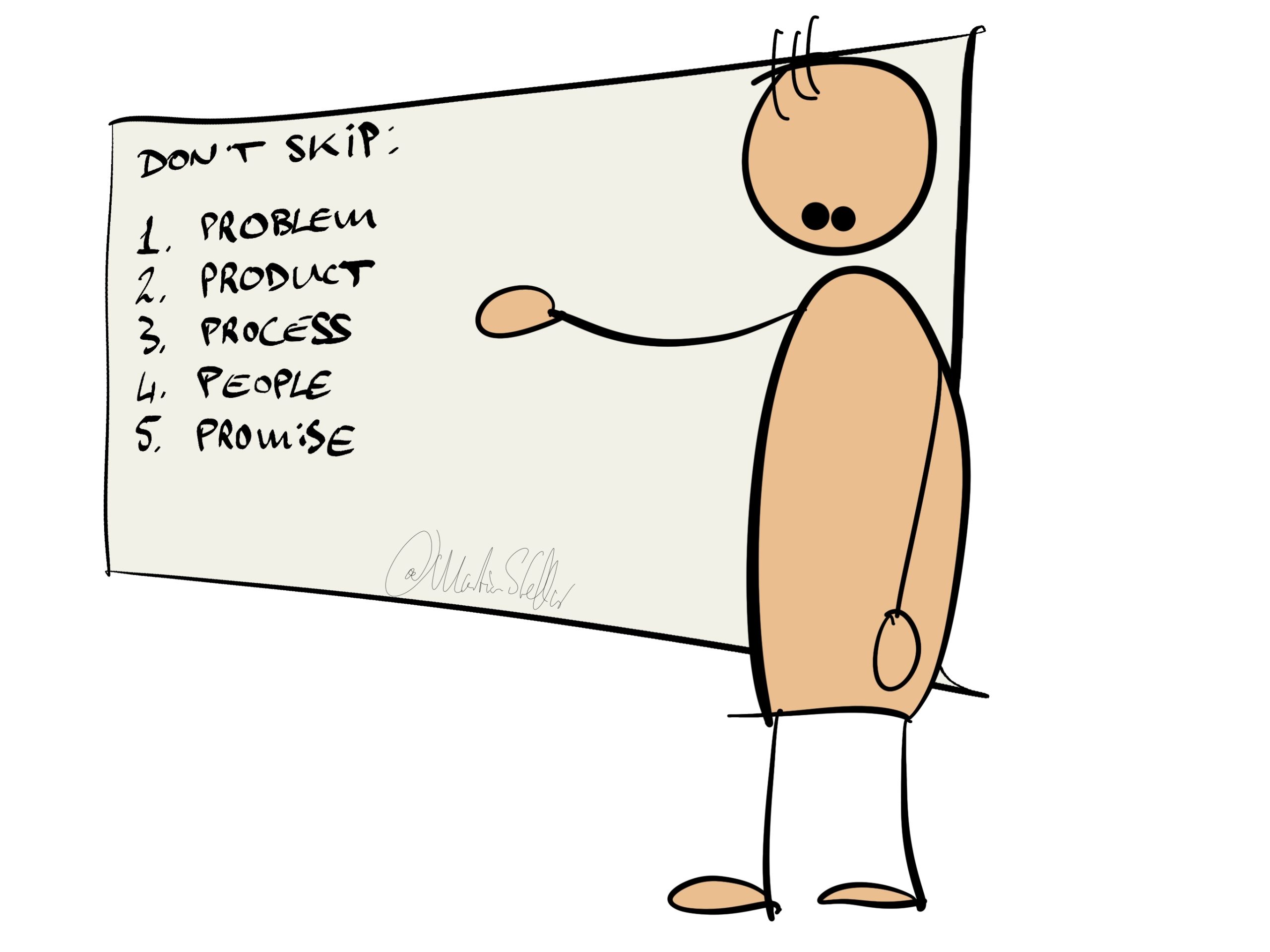
There’s a very simple stack of concepts that a business – any business – will need to have clear and precise definitions for, if that business is going to be stable and thriving.
Holds true no matter what stage you’re in. If you’re starting out, defining these 5 P’s will help you gain traction and reduce inefficiency.
If you’re established, they’ll help you strengthen against competitors and they’ll enable you to grow your sales.
And any time you have a challenge or goal or problem related to marketing, sales, growth and revenue, it’s a really useful exercise to write down or review your definitions of each of the 5 core points, the 5 P’s.
Because together they give you a hypothetical, testable answer to the question "How do I find strangers, and turn them into customers?" – and without a framework and structure to help you become increasingly accurate in answering that question, running and growing your business is going to be a tough slog.
But it doesn’t have to be that way, not so long as you create, review and update your 5 core points.
1. The Problem
That solution you have, the one that people need, for the problem that they are looking to get solved – what is that problem, specifically?
You need to have a real clear definition and description of it, and you also need to really love solving that problem, otherwise you’ll end up facing all kinds of undue trouble and hardship.
So you’ll need to figure out answers to questions like:
Why would people want you to solve it, instead of someone else??
And why now?
And how much will it cost them… if they don’t solve the problem?
The pattern here is: everything is about the problem that you’re on a mission to solve, the wrong that you want to right in the world. That’s where everything starts and you can’t afford to be vague about what that damn, pesky, costly problem is.
(Further reading: ⚠️ Hidden Sales Asset 3 – Your ideal buyer's Problem-stack)
2. Product
What product or service do you have that solves that problem?
What does it do for people? What does it not do?
What about your product do you need to communicate?
3. People
Who, specifically, are the right People for what you do?
Because if you try to sell to the wrong ones, you’re going to be churning a lot of time and wasting a lot of effort and resources.
Therefore: Who are the people you should ignore?
Also very useful: who are the people who could generate introductions for you?
(Further reading: Mine your network for opportunities
4. Process
What is your best, most reliable and most predictable process, for finding the right people, getting in front of them?
(Further reading: 👀 Hidden Sales Assets – Mini-training
And then once you Process gets you into conversations with the right people, once they know about you, once they are asking about your solution, you get the fifth P:
5. The Promise
What Promise do you make them?
What specific, measurable, beneficial outcome do they gain from your work, that you promise or commit to generating?
Why you should use the 5 P’s to keep your business on track
Whenever you find that things aren’t working the way you expect them to work, or you’re not selling enough, or people balk at your prices, or your growth has stagnated:
You’ll find the solution in reviewing and improving the answers to these 5 questions.
When something’s off with either Problem, Product, Process, People or Promise, your business stops growing or suffers, or you lose clarity on what to do and where to turn.
Whenever that happens, take some time to answer the 5 questions in detail, and you’ll very likely come up with insights or ideas on what you can change or improve.
And, if you want to talk through it with me, send me an email and let’s set up a time for that.